
Festivals in Muang Sing:
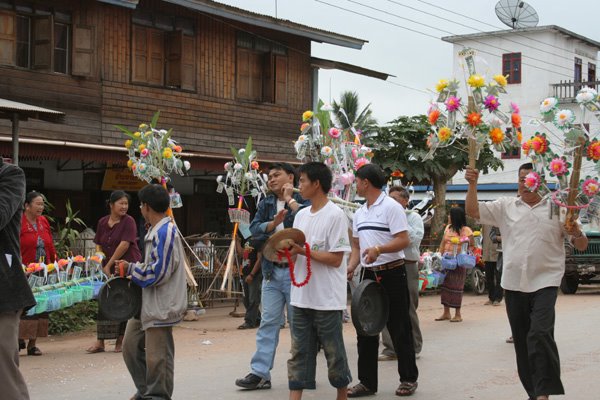
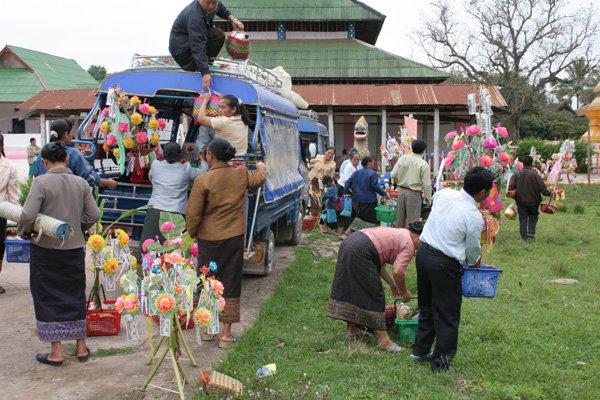
The main festival, called “That Xieng Tung Festival” revolves around a stupa 5.5 km outside of Muang Sing proper. “That” is the Lao word for stupa (FYI that is a hard, aspirated “t” sound, not a typical “th” like in the word “the”). This festival took place on November 16, the exact date of the full moon. However, 2 days before the main festival was a wat festival at Wat Xieng Jai, the temple right behind my guesthouse. Apparently this festival was particularly special since it only happens every 5 years. It involved people from all over Muang Sing, who brought gifts of food, money, and even material items such as bicycles and household objects. Of course these gifts were decorated with paper flowers, and were generally in the form of “trees”. It’s hard to describe but it was beautiful. I spent almost the whole day at the wat kind of looking around and then waiting for something to happen. It appeared that people just kind of arrived throughout the day, setting up their things, going into the wihan (main building) and making merit through offerings and prayer. The things were to be given out to the monks in a kind of “lottery” system, as explained by the woman who ran my guesthouse. At about 1:30 or 2 pm, someone began praying over the loudspeaker, and thus a group prayer began, lasting for, I’m guessing, about a half hour or so. After the prayer and another span of about a half hour, the things were distributed. The monks (and novices) each received these slips of paper wrapped in a banana leaf. The older monks got more papers, and thus more chances to get the main prizes or at least more prizes in general. The slips of paper appeared to me to be written in “Tam” (I’m not sure if that is exactly the write name), the language the Buddhist manuscripts in the area are written in, and as my friend Mathilde pointed out, only the men were able to read them (which makes sense since women would never learn how, not having the opportunity to become monks). When the monks found their gifts, they would read the prayers to the givers. It was great to watch, and I took many, many photos.
Then two days later was the main festival. Actually, I don’t have very much to describe here. Many, many people come from all over the area, including Yunnan in China. It very much has a carnival atmosphere. There were vendors everywhere, selling things to offer at the stupa, textiles, food, and the carnival booths (which included throwing darts at balloons, knocking over tin cans, etc). Not only the Buddhists show up, there are Akha people (hill tribe) everywhere as well, dressed in their finest. It was a great atmosphere and I stayed there for many hours. The Buddhist population carries flowers, candles, and incense as they circumambulate around the stupa. I think things may have happened before I got there or perhaps after I left, but again I doubt there was much to see specifically, and no banners were around that I could tell. The Akha were certainly followed everywhere by tourists with cameras (who doesn’t want a picture of the Akha? Their dress is really beautiful). I think what is special about this festival is not only the making of merit by making offerings and circling the stupa, but the opportunity for thousands of people to come from all over the region and have a good time.
posted by rebhall @ 1:58 AM
0 comments


0 Comments:
Post a Comment
<< Home