Friday, December 30, 2005

Street Life of Jinghong, or The Trash Man

I will be the first to admit that this specific blog entry will not be much of a revelation for those of you who have traveled in China, or perhaps other Asian countries (I wouldn’t really know), but oh well. I feel the need to share one of the most enjoyable things for me during my stay in Jinghong: watching, and listening to, the streetlife. Although there are plenty of cars to fill the streets, and each driver is more than happy to let the others know that he is there by honking the horn, the most fun and interesting are the two- or three- wheeled vehicles, specifically the non-motorized, pedal powered ones. These vehicles are used not only as a means of getting from one place to another, but also as a way to get any number of things around town: piles of produce, furniture sets, friends and family, etc. Again, this is nothing out of the ordinary for people who use what they have to the fullest extent possible, but it was great fun to watch each day. Yet, what particularly caught my attention and held it for 2 weeks were the people who made their living either selling things from their cycles or using their cycles as a means of receiving things from others. I think this is because these people used sound to announce themselves as the moved up and down the street. The sounds come in the form of a recording, of music or voices, played into a megaphone. It took me a couple of days to figure out what the random sounds and announcements were that I was hearing all of the time, but once I figured it out, I was thrilled. Let me explain by using my favorite examples. First is the “bread man.” His announcement was only 4 syllables, which I think referred to two types of bread he sold or to his bread in general. Of course I have no idea, since I don’t know Chinese… I am just guessing about his announcement, but I loved the sound of him coming up and down the street. The second example I have is my favorite. It was the trash man, who I got to see/hear every day at breakfast. The first time I ever saw or heard the trash man I was very confused. I kept hearing this sweet melody that sounded like a kid’s toy playing over and over again. It sounded like it was coming closer, but I couldn’t figure out what it was. Finally I saw him, and observed the situation. The trash man slowly rides his three wheeled cycle down the street, playing his melody over his megaphone. He would stop to either pick up the trash he saw on the street, or wait for people to bring him their trash. It seems silly, perhaps, but I enjoyed hearing the sweet melody of the trash man every day. I thought it was particularly interesting that his melody was played to attract trash, whereas in cities in the states, if we were to hear a sweet melody being played in the street, I think we would assume it was the ice cream man, intended to attract hungry children (and adults).


Thursday, December 29, 2005

Jinghong, Xishuangbanna, China
(that's Chiang Rung, Sipsongpanna for those of you who want the Thai version)

Photos:
1. Dai roofs
2.Dai wat, Galanba
3. Hotel "pond"
4. Around Jinghong
5. In the market


I am not going to pretend like I was entirely productive when I was in Xishuangbanna. I am not sure entirely for this lack of productivity, but I can definitely make up excuses, including the fact that for the entire two weeks that I was there (minus 2 days), the weather was unbearably cold. No sunshine at all, and it even rained for the better part of 3 days. Although I am frustrated with the lack of work I got done, at least I actually finally got there, and can now confirm that their banner tradition is going strong.

It was evident from the moment I stepped off the plane that I was in China and no longer in familiar territory. I was greeted by a uniformed customs guy: “Welcome to China!” I enjoyed his friendly welcome. Once I got out of the very small airport, I wasn’t really sure what to do. A taxi driver came up to me and said who knows what to me, when I realized that I actually had no Chinese money at all. Luckily a woman standing next to me spoke English and so I told her I needed to get to a bank and hotel, etc. The next thing I knew I was in the back of a taxi, completely unable to communicate with the driver and heading into town. I can admit now that I did feel a bit more culture shock than I expected upon arrival to Jinghong. Not being able to communicate was really a change for me after being so spoiled in Thailand and Laos. But I did end up at some strange Chinese hotel for my first night. Certainly I paid too much, but I couldn’t really be bothered since it was more important for me to adjust to being in Xishuangbanna, get orientated, etc. After putting my stuff down in the room, I wandered around a bit. After getting completely lost, and near panic (again, confusion over language), I found my way and was able to locate the “backpacker”-ish part of town. I ate dinner and went back to my room to watch the Table Tennis Women’s World Championships on TV. Wow, fascinating. And a Chinese woman won (believe it or not)!

I was very fortunate my second day in Jinghong, because I tossed a coin and decided to check out the Wan Li Dai Style Guesthouse. They didn’t have a whole room available, but had a bed (some rooms, they call “dorms” but really only have 3 beds, they rent by the bed) available for 20 Yuan (8 Yuan = 1$). The place seemed very nice and (most importantly) clean, so I took a bed. My roommate turned out to be a German woman named Iris who was on her 4th trip to China. Iris was very friendly and knowledgeable, and helped me to get more accustomed to being in China. She was planning on going to a town (Menghun) a couple of hours away the next day for the Sunday market and invited me along. I had been thinking about possibly doing the same thing and was not fully sure of where the bus station was, and everything else, so I jumped at the chance to travel with her. In doing this, I not only had a traveling companion, but I also got to see where the No. 2 bus station was and how to get a ticket, etc.

It was nice getting out of Jinghong, and the mountains (hills) were very beautiful, even if they were stripped of their original forest growth. I want to make a note here that not all of Xishuangbanna is stripped of its original forest, but much of it has been, replaced by tea farms, rubber tree plantations, and pineapples. Anyway, the town we went to, Menghun, was small but nice, with 2 wats in town. Tourists go to Menghun for the Sunday market, which I thought was really only mediocre, but maybe this opinion comes from having been to so many markets already in northern Laos. However, I do know 2 things about my trip to Menghun: the first that it was the beginning of my being very, very cold while in Xishuangbanna, and second that Iris and I were very fortunate because a traveling group of Shaolin monk performers had come to town the same day as us and were performing that night (see other blog). The place we spent the night was also quite interesting, notably the toilets which drained right into the “pond” the rooms opened up to. Ah China… definitely not known for its clean toilets.

Another place I traveled to in Xishuangbanna was Damenglong, again with Iris and another friend from our guesthouse, a completely unusual (unique?) Swedish guy named Pärolof. This time the slow bus ride reminded me of being in Laos – the road was unpaved, bumpy, and dusty. I enjoyed the sleepy town, its friendly people, and its wats.

The Dai people (who are the people in Xishuangbanna who are Theravada Buddhists and closely related to the people of Laos and Thailand that I like so much) have an incredible architecture style which includes homes that look like roofs on stilts. I really enjoyed exploring their villages and visiting their wats. Many of the wats in the Dai villages and towns are built or rebuilt within the last 10-15 years. This is a result of the destruction of Dai wats during the Cultural Revolution in China. The newly built wats try to maintain the integrity of the traditional ones, but they are typically not made from wood, which tends to affect their appearance. It is still possible to find the older temples in some villages, and I was very happy to explore a number of them.

Most of my time was spent in Jinghong, riding bicycles into the surrounding area, taking the minibus to a nearby town, Galanba, and observing life in the major city of Xishuangbanna. I did mope a bit as a result of the crappy weather, painful blisters, and a very painful mouth problem I had for a few days related to the wisdom tooth I have yet to have pulled out. Being in China really grew on me after I adjusted to not wanting to speak Thai to everyone I interacted with, and I can say I really can’t wait to explore China more. It is such a large country, and there are many places I want to go there. I know most people consider being in Xishuangbanna as hardly even being in China, but it was China to me.


Monday, December 05, 2005

The Mighty Mekong


Mekong at sunset


05-12-05

OK, I know that by posting this blog today I am now skipping much of my Lao trip, but since this is the most recent thing to happen, and it is such a ridiculous amount of travel and trouble that I thought I should go ahead and write about it while it was fresh in my mind. Sorry for the length of this posting. I guess in wanting to share the ridiculousness of this experience I tend to get a bit detailed. So I mistakenly traveled to Laos and didn’t have the foresight to purchase a plane ticket from Luang Prabang to Chiang Mai for when I returned rather than trying to get back over land (or river as the case may be). That was a huge oversight, as it turns out. I am not sure what I was thinking, or, perhaps more precisely, what I wasn’t thinking. But anyway, I had it in my head to get to Luang Prabang maybe about a week before I wanted to leave the country so I could purchase a plane ticket then. Perhaps during low season this would have worked, but as the case may be this is high tourist season. So when I got into Luang Prabang, I checked into a great guesthouse (the guy who ran it, Kong, was so very sweet), took a hot shower (the first in seven days or so), then went to a travel agent. Who proceeded to tell me that all the planes were full. Great. What are my options to get to Chiang Mai? Fast boat or slow boat to the Thai border, then a mini bus (for tourists) or the regular bus. So, the fast boats get you to the Thai border in something like 6 hours, but they are notoriously dangerous and even more than that they are very loud and quite uncomfortable (mind you, this is a relative term here. After all of my transportation experiences, the meaning of uncomfortable really does change. I think they are no less comfortable than many things I have ridden on/in, but on a fast boat you can’t stand up every so often to get circulation into your legs). You can guess that my nervousness about traveling would influence me to choose the slow boat. There was just no way I would gamble that, while nearly all speed boats have no problem whatsoever, my speedboat would arrive with no trouble either.

OK, so the travel agent guy said that I could pay for the slow boat which would get to the border at around 4 or 5 the second day, then cross to Thailand and take a mini bus at 6:30, thus getting me into Chiang Mai Sunday night, giving one whole day to decompress before my wonderful pal Julia gets to town. After spending 4 days, plus an hour another day, on boats in Laos, I wasn’t particularly thrilled to have to spend 2 more days on boat, but if that was the way to get to Chiang Mai, so be it. I even purchased a place on the mini bus, the first time I have ever purposefully taken tourist transportation instead of the local option. But I really wanted to get back to Chiang Mai as planned. So thus I lost a day in Laos, but what can you do – I knew I’d be back. Then, as I was paying for my boat/bus ticket to Chiang Mai, I realized something horrible, but important – I had lost my wallet. It was nowhere to be found. I couldn’t believe it; my heart just sunk and I ran back to my guesthouse. I talked to Kong, then ran to the boat landing. Couldn’t find my boat anywhere, even after asking the other boat people who directed me to go far down the bank of the river from where I was. OK, not far, but not close. Maybe like 100-200 meters or so. Defeated, I went back to my guesthouse. I got sympathy from Kong, who promised to go back with me early the next morning (I think he was pretty sure my Lao wasn’t quite competent enough, and that I might have more success with a native Lao person. Very sweet guy). But still no wallet the next morning either, although we did find my boat and talked to the captain (who was speaking Thai from what I could tell).

Fast forward through my stay in Luang Prabang, which I think was too long, but after losing my wallet and losing a day to the slow boat, I just couldn’y quite muster up the energy to travel anywhere else just to return to Luang Prabang. Mistake, yes, probably so, but what can one do? So, I got up early on Saturday the 3rd of December, and got myself ready to go to the boat. Said goodbye to Kong, who was surprised I would go back on the slow boat after losing my wallet on the other one, but what else could I do? I was very sad to think that I was boarding the boat with the intention of leaving Laos, a country that affects me so much each time I come, but knew I needed to be getting back to Chiang Mai, not just for Julia, but to sort out my wallet fiasco as well. Luckily the boats aren’t nearly as crowded heading upriver. And then we were off. Nothing much to talk about here. Loud, slow, beautiful scenery. Sadness in my heart. I knew passing the landing for Hongsa would be particularly difficult since I had such great experiences there and for one thing don’t want them to forget about me and also can’t wait to get back. I realized that this German couple whom I had met 2 days earlier and who had talked to my Australian friends about Hongsa were going to get off there. (See what happen when I skip writing so many days? Who are these Australians and what on earth is Hongsa??) Well, I was excited after confirming with the Germans that this was in fact their plan, and I told them not only to have fun, but that they had to tell the guesthouse people that I said “Hello!” Actually, I think it was more like, “I doubt they’ll remember my name, so can you just please tell the Jumbo Guesthouse people that the crazy American who can speak Lao says hi?” I can’t even imagine what this German couple was thinking. I do admit I get a tendency to get very excited and enthusiastic about things. But then, after hopping back to my seat, I decided this wasn’t good enough, and proceed to attempt to write a short note to the guesthouse people in Lao (which I am not as comfortable writing as I am Thai). I ran back up to German couple and said “Look! I wrote them a note! Can you give this to them instead?” They wondered who on earth to give it to, and I said “Anyone at Jumbo Guesthouse or Lotus Café! They just took such great care of me there!!” Those poor Germans. I don’t know if the note got delivered or not, but I was excited at the time, and it helped my get past Hongsa without crying too much.

Got into Pak Beng, the halfway town, a bit after dusk. Stayed at the first place I found and befriended a German and a Norwegian with whom I ate dinner and shared some beer Lao. Back to the guesthouse for some sleep, then up early to go check out the local temples, something I didn’t do when I was in town a week and a half earlier (or whenever that was). Ate breakfast, then back on the boat. Not too happy to be back on the boat, but again, at least it wasn’t crowded and everyone was nice. This second day was a very long day. Going upriver (and against the current) is very slow and clearly hard on the motor. And while I was so sad to leave Laos and thought so fondly of it and the wonderful Mekong River through much of the boat journey, I began to get pretty anxious to get off that boat. Then the anxiety grew and grew as time passed and we got closer to 6 pm (when the border closes). The next thing I knew, we were pulling into dock at Huay Sai (border town on Lao side), it was already dark, and 6:30 pm. How powerless and frustrating. Needless to say, I knew then that I wouldn’t get to Chiang Mai that evening. Once the boat was docked (and it took another 10 minutes or so to get in just right and then be able to get off the damn boat), we got off and there guesthouse people trying to see their guesthouses to us. They confirmed it: no way to Thailand that night. Excellent. I was completely out of money, and then I had wasted another $10 on the minibus that was heading to Chiang Mai without me. I took off from the dock with my Norwegian friend, Lasse, but then we realized we were the only ones walking away. No we weren’t, we ended up walking with a Canadian couple from Quebec. Walked pretty darn far to the main part of town, but not without walking down a road that had no bridge and thus retracing our steps first. My god could it possibly get any worse?? We ended up staying in a very nice guesthouse for $5 and grabbing a ridiculous dinner with other people from the boat also trapped in Laos (they had taken a free tuk-tuk to their guesthouse. Great). We were all planning on the minibus in the morning because it was much faster than the local bus. The minibus was to leave at 10:30 in the morning, so I planned to sleep, then cross the border first thing in the morning and get things sorted out on the Thai side of things.

Woke up, grabbed my last delicious Lao coffee for the time being, visited the local wat, and then went back to the guesthouse. Grabbed Lasse and crossed the border with absolute ease. Then talked to the guy standing next to the “minibus to Chiang Mai: good driver with drivers license” sign and found out that the minibus was already full. NO! You HAVE to be JOKING! Lasse was having stomach problems and wasn’t sure if he was going to continue to Chiang Mai or not, but I ran up to the tuk-tuks determined to get to bus “station” because a bus was leaving for Chiang Mai at 9 am (it was probably 8:50 at this time). Of course I didn’t have anything smaller than 1000 Baht, and the tuk tuk cost 20 Baht. Lasse had not Thai Baht, and I tried to explain the situation to the tuk tuk drivers (in Thai, although at this point it was more like Lao-Thai). I explained that I had lost my wallet in Luang Prabang (they were surprisingly sympathetic) and had used all of my small Baht bills in Laos along the way. Finally it was decided that they could find the change for my large bill, and then we double checked about the minibus. Yes, full! Off to the bus stop, ran in, but the 9 am bus was full too! NOOOOO!!!! The next bus left at 11:40 and would get into Chiang Mai at around 6:30. No joke. My heart just sank. I bought 2 tickets anyway (Lasse still had no Thai Baht since we had no time to stop at an ATM) and the woman was very nice and friendly and got a total kick out my ability to speak Thai.

Fast forward to the bus ride. It was so upsetting to think that I was going to be getting into Chiang Mai nearly 24 hours after I had thought I would, after so much time on that damn boat! I can hardly describe the feeling. Lasse and I were not the only ones from the boat there waiting either. The same Canadian couple were going to take the bus, as were these 3 Korean guys who spoke hardly any English but were quite hysterical to watch and very friendly. Finally, the bus pulled up and we got on! It wasn’t particularly comfortable or exciting, but at least we were on our way. Finally. The bus filled up a bit in Chiang Khong, and more and more along the way. This day was a holiday, the King’s Birthday, and I think many Thai used the 3-day weekend to travel. Still, I was just happy to finally be on track to Chiang Mai. Then we pulled into some larger town (not quite a city, but it felt enormous after being in Laos for so long – I mean it had a real bus station) and many more people got on the bus. Standing room only! The tickets were checked, and we should have been back on the road. But we weren’t. We were just sitting there. It made no sense, and no one was doing anything. They hadn’t announced a break, which is what they normally do, so what was going on? Lasse and I both were getting increasingly upset. Then one farang (westerner) and one Korean got off the bus. Great, get back on, I was thinking, or we’ll be here forever! More time passed and slowly more and more people seemed to be getting off the bus. As it cleared out, suddenly we realized that the bus was having engine trouble. Unbelievable! No one had said anything, and it was unclear how long it would take. So I grabbed my small backpack (which I have been guarding very closely since beginning my journey since it had my laptop and camera in it) and exited the bus as well. Talked to the Canadian girl a bit, then a Thai woman came running up to us. She spoke fabulous English and told us that she had to get to Chiang Mai to catch a bus to Bangkok, so she hired a car and wanted to know if we wanted to share it. The cost would be about 200 Baht and we could get a refund for our bus tickets. She was convinced that it would take forever to fix the bus. So the Canadian girl and I waited for her significant other and Lasse and we decided to go for it. We got the refund and Lasse went to get the bags from the bus. We met behind the bus, when I realized that my basket from Muang Sing with all of my food was still on the bus! Lasse was so sorry he forgot, so tried to get onto the bus to get it. Just then 2 Thai people on the bus were giving me the thumbs up signal – the bus was fixed! Oh no!, I thought. But we had already gotten the refund. I still needed my basket! So I got past the bus driver and went to get my basket. Right then everybody else who had gotten off the bus decided to get on so they could be on their way. But I still needed off! Desperation! I was so frustrated. Apparently it was funny to Lasse and the Canadians to see me trying to fight my way off the bus. I finally did, and we climbed into the back of a songthaew (the trucks with the 2 rows in back that I have mentioned before) and were off!

It was pretty funny, in a rather tragic kind of way that can happened when you travel. The 4 farang were chatting together and having a good laugh when it started to rain a bit. Great! I thought the rainy season was over! I hadn’t seen rain in nearly 2 weeks, but timing is everything. So we realized, as did the Thai passengers, that our backpacks were on the roof, so we got the driver to pull over and we pulled the packs in with us (which made it quite a bit more crowded). And we were off again. The driver was going a bit fast, but I have to admit I wasn’t too worried until it really started pouring and then the morbidly phobic traveler in me came out. It really wasn’t too bad though. As we were driving, a small plexiglass window had blown out and one of the Thai girls was getting wet, so we pulled over again to try to fix it. Then we were off again. In the meantime, our bus came up from behind us and passed us. Unbelievable!

All in all, the songthaew ride was pretty uneventful, although a bit long. We chatted a bit and had a decent time of it, but we were all anxious to get done with the endless travel. We FINALLY pulled into the Chiang Mai bus station at around 6:30 or so, and I was home by probably 7:15. Very happy to finally be back in Chiang Mai. In fact, the absurdity of my travel between Luang Prabang and Chiang Mai did actually cure me of my moping and sadness about leaving Laos. And in fact, although I am a bit sick of boats and the slow travel, I do feel safest on these slow boats and they are sometimes about the only means of transportation to places in Laos. This journey seems rather absurd, to me and probably those of you reading this, but as it goes, this really is par for the course when traveling in Southeast Asia, even Thailand which seems so very wealthy compared to its neighbors.

Friday, December 02, 2005


Festivals in Muang Sing:

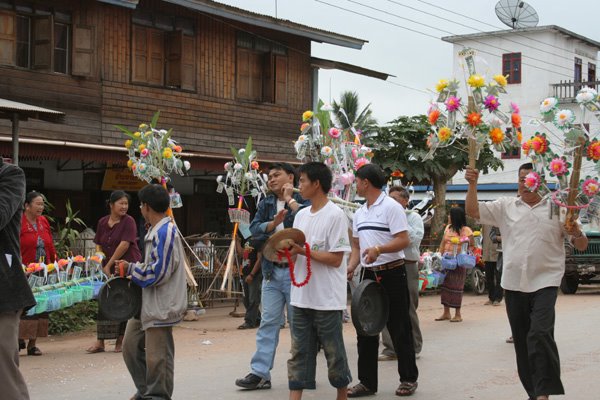
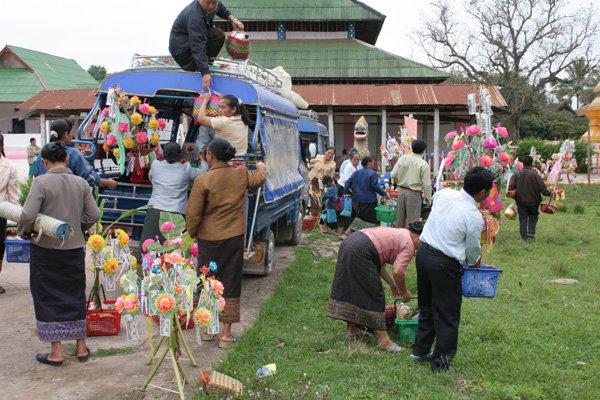
The main festival, called “That Xieng Tung Festival” revolves around a stupa 5.5 km outside of Muang Sing proper. “That” is the Lao word for stupa (FYI that is a hard, aspirated “t” sound, not a typical “th” like in the word “the”). This festival took place on November 16, the exact date of the full moon. However, 2 days before the main festival was a wat festival at Wat Xieng Jai, the temple right behind my guesthouse. Apparently this festival was particularly special since it only happens every 5 years. It involved people from all over Muang Sing, who brought gifts of food, money, and even material items such as bicycles and household objects. Of course these gifts were decorated with paper flowers, and were generally in the form of “trees”. It’s hard to describe but it was beautiful. I spent almost the whole day at the wat kind of looking around and then waiting for something to happen. It appeared that people just kind of arrived throughout the day, setting up their things, going into the wihan (main building) and making merit through offerings and prayer. The things were to be given out to the monks in a kind of “lottery” system, as explained by the woman who ran my guesthouse. At about 1:30 or 2 pm, someone began praying over the loudspeaker, and thus a group prayer began, lasting for, I’m guessing, about a half hour or so. After the prayer and another span of about a half hour, the things were distributed. The monks (and novices) each received these slips of paper wrapped in a banana leaf. The older monks got more papers, and thus more chances to get the main prizes or at least more prizes in general. The slips of paper appeared to me to be written in “Tam” (I’m not sure if that is exactly the write name), the language the Buddhist manuscripts in the area are written in, and as my friend Mathilde pointed out, only the men were able to read them (which makes sense since women would never learn how, not having the opportunity to become monks). When the monks found their gifts, they would read the prayers to the givers. It was great to watch, and I took many, many photos.

Then two days later was the main festival. Actually, I don’t have very much to describe here. Many, many people come from all over the area, including Yunnan in China. It very much has a carnival atmosphere. There were vendors everywhere, selling things to offer at the stupa, textiles, food, and the carnival booths (which included throwing darts at balloons, knocking over tin cans, etc). Not only the Buddhists show up, there are Akha people (hill tribe) everywhere as well, dressed in their finest. It was a great atmosphere and I stayed there for many hours. The Buddhist population carries flowers, candles, and incense as they circumambulate around the stupa. I think things may have happened before I got there or perhaps after I left, but again I doubt there was much to see specifically, and no banners were around that I could tell. The Akha were certainly followed everywhere by tourists with cameras (who doesn’t want a picture of the Akha? Their dress is really beautiful). I think what is special about this festival is not only the making of merit by making offerings and circling the stupa, but the opportunity for thousands of people to come from all over the region and have a good time.


17-11-05

Well, I am sitting here in my guesthouse room in Luang Nam Tha with the intention of writing about my experience in Muang Sing for this blog. But perhaps it is too soon since I have been there to really process the information. I went to Muang Sing because ever since reading about it I had a hunch that it might be a good place for research, for seeing about banners and Tai Lue weaving in general. I went at this time specifically because I knew there was an important festival held at the nearby stupa. This festival comes on the same day as other notable festivals in Thailand and Laos, and I believe they relate to the end of the rainy season and the rice harvest. Regardless, I was excited to get to Muang Sing, a tiny town not even 10 km from the Chinese border. Once there, the sun was shining, a welcome respite from the rain and intense amount of mud I had been dealing with for the past couple of days. I settled into the Muang Sing Guesthouse, a nice guesthouse where I could have a clean room with 2 small beds complete with mosquito nets and an attached bathroom all for $3. The guesthouse was owned by a couple who also owned the Tai Lue Guesthouse across the street – they were very nice and friendly. The room had a window overlooking a wat (temple), I thought that would be a good thing, especially since the banners I was looking for would be in the wats, and because I really enjoy being in or around the temples. Well, perhaps being next to a wat during an important festival isn’t the best idea in the world. Needless to say that one night after an important day of merit, the monks (or someone) started chanting over the loudspeaker and banging on the large drum at 1 AM! Apparently (as confirmed by my wonderful neighbors) they didn’t take a break until 5 hours later! Didn’t get much sleep that night. But it was good. No, it was great. Who can complain about celebrations?

I ended up spending 6 nights in Muang Sing. And I hardly regretted a minute of it. Sure, there wasn’t a whole lot to do in the town. Only one street is paved! Most tourists stay for one night, maybe two, but I have noticed that the longer you stay in a place, the better you get to know it. Each day (or nearly every day) I rented a single speed bicycle and conquered the surrounding area looking for temples to wander into. At first I was very unsure and shy about everything – wandering up to a temple, al the novice monks just staring, what if it the main building was closed, etc. But I learned immediately that such worries were unnecessary. And it is very rewarding. The monks (or usually novice monks) are so incredibly welcoming, and make a point to open the main building for me if it is locked. And each one has had gorgeous banners hanging in them. Excellent!

I can honestly say that traveling alone does get old at times. It can be lonely, especially when most travelers are in pairs or larger groups. And the Lao are always pointing it out because they don’t particularly like it. But I was very fortunate in Muang Sing to meet many wonderful people. My first night I ate dinner with a small group of tourists from all over – Spain, Italy, Brazil. It was fun. A couple of nights later I met a woman from Holland spending a couple of weeks in Laos before going scuba diving in southern Thailand. Then a few of us who had been in town for a number of days formed kind of a small group at the first temple festival and we ended up eating together pretty much every meal after that. It was good meeting them. The group consisted of: Michael and Fiona, from New Zealand; Otto, a nuclear scientist from Germany who has done quite a bit of work in China and is quite a well traveled man; Mathilde, a French girl who had been interning in Luang Prabang for the past 5 months; and me. We had a lot of fun.

Needless to say, by the day after the main festival, the day I had scheduled myself to leave Muang Sing, I didn’t want to go. All of my new friends had left already – at 5:30 in the morning, no less! – so that helped motivate me. I went to the market early and bought a plastic basket like the ones the women in the area used daily. Then when I ate breakfast, the woman who runs the guesthouse brought me my food and told me I was welcome to stay in Muang Sing as long as I wanted. I felt so bad! Oh how I wanted to stay! But I told her that I was planning on leaving to go to Luang Nam Tha that day and so she left and came back to my table with a bag of fried banana chips for me to eat on the bus. How sweet is that?! So, reluctantly, and with tears in my eyes, I left Muang Sing to return to Luang Nam Tha and more explorations of local wats!


I am posting many pictures of Muang Sing here, just because they are so enjoyable and because I can. Th photos include: a view from my guesthouse roof at dusk, monks riding in the back of some Chinese vehicle, Muang Sing valley, Tai Dam women selling textiles, inside a wat (temple), and monks' quarers at a different wat. Enjoy!
And sorry the photos are placed so poorly. I am still trying to figure out this photo posting thing.


Muang Sing, 11/13/05:

Muang Sing is a fabulous area. I think it has been a difficult transition for me to go from absolutely stressed and without spare time to having lots of free time. I am trying to keep myself busy going around to temples and things, but the pace of life here is, to say the least, much slower than what I am used to. I think I will be able to adjust in time, but it is strange. And I am so worried about reading my book too quickly and then having nothing to read that I have hardly read any of my book. It makes little sense, but I never claimed to be fully logical and without neuroses. I have been riding my bicycle (that I rent for a whole $1 a day) around to different villages and trying to go into the main building at the temple to see if there are banners and of course photocopy them. I think I have been largely successful, although certainly not all buildings are open and I tried to ask a couple of questions and had little luck. I have been splurging of eating – I spent a whole 20,000 kip on lunch today and then another 20,000 kip on dinner tonight! OK – one dollar is about 10,000 kip so that’s $2 per meal, but that is definitely decadent in this part of Laos.

I am now just waiting for the festivities to begin. There is a temple festival tomorrow and the important That Xieng Tung festival on Wednesday. The townspeople were really getting ready for the temple festival today. The women were all working on making food and offerings all day. You could see this all over town. And the men at one point were practicing their instruments. Oh, I love it! Can’t wait for the festivities, and I am sure they will be as rewarding as I think they will be.